

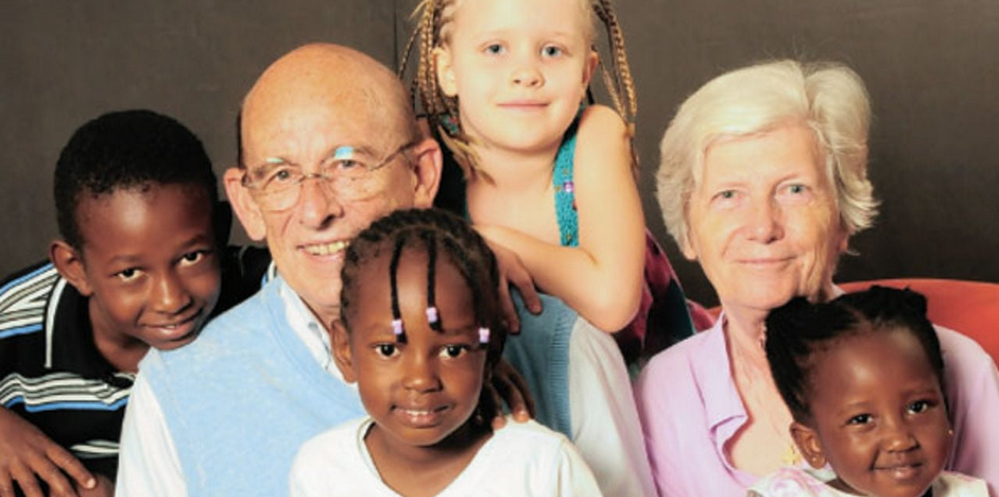
The Munros are inspiring pioneers in integration. Although they were already mavericks, they were thrust into a major life move that was not planned – it literally arrived on their doorstep.
I first met the Munros when I married Feargal and moved down from Samburu to live in Muthaiga, Nairobi. For my first time, this transition and integration, was on a permanent scale. I was living in one of the most luxurious quarters of Nairobi and learning to be a housewife with domestic staff. It was all terribly exciting and challenging – a huge learning curve as I had previously managed to avoid domestic life with its accompanying skills.
The Munros were our neighbours and Feargal’s good friends. Ingrid Munro is a Swedish architect who worked for Habitat at the United Nations and her husband, Bob, a Canadian, who worked as a consultant on environmental and social projects. They had two teenage daughters, their eldest, Mia, is Korean (adopted) and second daughter Millan was a very blond Swede. Always so welcoming and great fun, they were there to celebrate our first son’s birth in 1988, just before their lives were about to be transformed with the unexpected arrival of their first son, Waithaka.
Waithaka was born in Mathare Valley, a very impoverished area in Nairobi. Soon after his fourth birthday, Waithaka joined a group of young boys begging on the streets in central Nairobi. With his sunny smile plus his talent at imitating Michael Jackson’s dancing, he soon became the most successful member of his group in charming tourists, eventually becoming their leader.
On the streets, the boys all shared their miseries and money, but in 1987, Waithaka was run over by a matatu. Both legs were so seriously damaged, that the doctors wanted to amputate his right leg. During this time Bob had been introduced to Mathare, Waithaka’s old world, through their good friend Father Arnold Grol, a Dutch priest who founded and ran the Undugu Society. He was the saviour of many street kids. Along with his many other roles, he loved jazz. He taught the kids to play it and together they formed a jazz band. His Mathare Jazz Band became renowned and even played at gigs hosted by the United Nations in Nairobi. Bob was an avid sports fan and had seen how these street boys loved to play soccer. Not having access to any soccer balls, they would make them out of masses of plastic garbage and string. Bob saw an opportunity for this sport to be a channel that could empower the youth to aspire to, and achieve their higher potentials. He soon began a soccer club called MYSA – the Mathare Youth Sports Association. This quickly became very popular and has been a great success. In the club the boys also learn about respect and responsibility, for they also had to take their turns at being referees for their games.
Discharged from the hospital with still large and open wounds on his legs, Waithaka kept hopping on one leg from the Undugu home to look for this younger brother on the streets. His leg became seriously infected again so Father Grol brought the injured child to the Munro’s house and asked for their help saying, “that little boy has the smile of an angel.” By the next day they realized they were going to adopt a son. In a pioneering court decision in 1990, Waithaka became their legally adopted son. It was this ruling by Judge Joyce Aluoch that opened the door for inter-racial adoptions in Kenya. It is also likely the only court ruling where the word “love” is used so frequently. This decision was helped by the fact that the Munros were already an inter-racial, integrated family.
However, Waithaka never stopped worrying and searching for his little brothers and Kareithi and Maina. He would take Bob and Ingrid down to the Mathare slums to look for them. One by one the Munros found them and adopted them into their family as well.
Waithaka attended several private primary schools, and had many friends during the day but was rarely invited to the children’s homes. So, in January 1998 he transferred to the Swedish School which had many other rainbow families and students. Despite the challenge of a new language, his grades improved. He even climbed Mt Kenya three times.
Waithaka helped inspire MYSA, showing in his own life what a young boy from the slums can become and achieve when given “a sporting chance”. Despite his crippled leg and often on crutches, Waithaka still insisted on joining Bob on many weekends to meet and reassure his many friends in the Mathare slums and MYSA that he had not forgotten them.
Waithaka never stopped caring about the kids and mothers he left behind on the streets. Ingrid says that her work had been dealing with the poor and their housing and she was considered an expert in it, but it was Waithaka who really taught her about the world of poverty. He would take Ingrid down to meet all his old friends and his first adoptive street-mothers who had often protected him when he was small, guarding for him the little extra money he sometimes earned in begging. They were some of the poorest of the poor and despite any amount of hard work they could not get out of the slum. She knew they were devoted mothers who wanted to raise their families well.
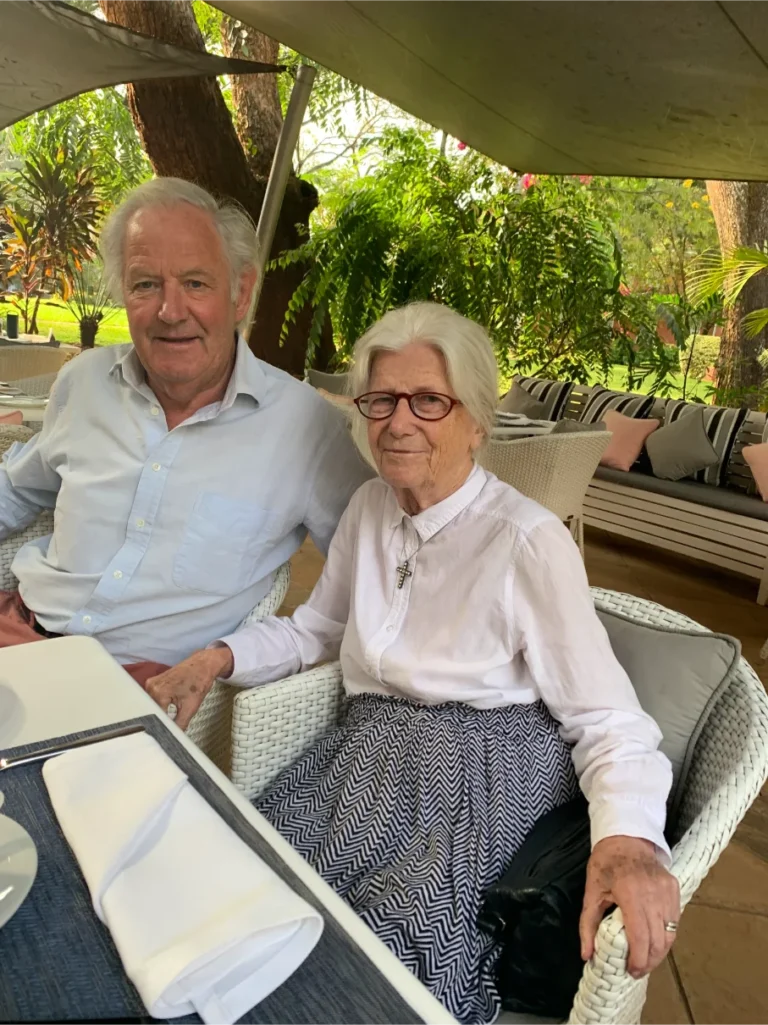
My husband, Feargal with Ingrid Munroe in Nairobi, 2025.
So when she retired in 1999, upon their request, Ingrid founded a micro financing organization together with fifty of these women. They named it Jamii Bora, which is kiswahili for Good Family. These intrepid, hard-working women, once given a chance started to sell small goods. For example, some travelled to buy some sukuma wiki (a popular spinach type vegetable) and bring it back to sell for a small profit. Many were illiterate and had little maths skills. At the beginning this was not a problem as the sales were small, but as they began to grow their businesses to customers that used cheques, etc. Ingrid arranged for them to have basic business training courses. As time went on, they expanded their services to cater for the women’s growing needs. For example, when they found that some of the women were not repaying their loans, they investigated to find that it was mainly due to illness in the family. No one there had health insurance so when a family member became ill all the women’s money went to pay for their medical care. As a woman, Ingrid knew that no mother could let their sick child die due to lack of medical attention because they had to pay back their loan with the money that could save their child or family member. Ingrid looked into health insurance but it was impossible for these women to afford the coverage that they needed. So Jamii Bora started their own health insurance scheme, and ensured that it would cover not only the member, but their family, too. This solved that problem, which had plagued many of them. Because it was all non-profit, it was affordable at small amounts per month and even covered maternity costs, which other health schemes would not usually cover.
In June 2000 Waithaka graduated from the Swedish School. In 2000-01 he then went for further studies at Birka Folkh6gskola. On returning from Sweden, Waithaka joined the then new and small Data Processing Unit in Jamii Bora. Over the next decade he helped recruit and advise many new members and staff. During this time the word spread of their great success as these impoverished slum dwellers returned to respective families up country for celebrations such as Christmas and for the first time were able to bring gifts and food home with them. That group of 50 women in a Nairobi slum has become an organization of 300,000 throughout the country.
Right from the beginning this organization took a holistic approach to making life better for these women and families. Life is complex so solutions must be dynamic. All of their staff members are chosen from within the organization and these women who have come out of poverty coach new members who have almost lost hope in their lives and futures. They know that the most important thing for their success is to get out of the hopeless mentality and believe that they can succeed, too. This works when they see that the women who used to beg next to them on the streets are now businesswomen who want to help them.
One year, suddenly Jamii Bora found that many of their members had lost their money all during the same period. They realized they needed and consequently started a disaster insurance scheme. When family members became addicts it severely affected the women’s ability to succeed because addicts will steal from anyone to buy their “fix”. They have even beaten the women in order to get the money. So Jamii Bora started an addiction program, employing two trained counsellors, who had been addicts themselves, to counsel the women and families.
Getting out of the slum had been a dream that many could not believe in, originally. Now however, Jamii Bora has a housing project that Ingrid, as an architect, is designing. There are of course, many obstacles to overcome when one develops such a new and dynamic project that no one believed was possible. Against many odds, this project is succeeding beyond their wildest dreams. It has grown according to the needs and is very much driven by the women so they are very cautious with donors, especially those who are commercially driven. They have created an organization that is now so uniquely and perfectly suited to assisting their needs they do not want to relinquish control.
In 2006-07 Waithaka met and married Brenda in a traditional ceremony. They were busily finalizing together the arrangements for their formal wedding planned for May 27, 2008 when their unborn daughter Sofia, who loves family events, decided to make her debut several weeks early and arrived the day before.
Despite the many challenges in his own life, Waithaka’s constant cheerfulness, his caring and compassion for others and his willingness to share himself and whatever he had with others, touched and affected many lives in and outside Kenya. He had suffered terrible pain with his injured leg for over two decades and in 2012 it was amputated just below his knee. But they also discovered cancer in late 2012. .On 29th January 2013, Waithaka passed away. He is sorely missed by many.
Brenda and their little daughter, Sofia plus Waithaka’s brother, Kareithi, his wife and 2 children all still live together with Bob and Ingrid in their home in Nairobi. Maina, Waithaka’s youngest brother, is studying at a university in Sweden and to be married there. He is working towards a Master’s Degree in International Development at Malmo University in Sweden. Mia and Millan and family also live in Sweden and they are all in close contact. Written together with Ingrid in 2013, Nairobi, to include in a manuscript I was writing.
Fast forward to 2025, we were back in Kenya with Ingrid again. Bob had sadly just passed away after being appointed to the Order of Canada in 2022 and named an Elder in the Order of the Burning Spear in late 2024 by the Kenyan president. Now in her eighties, Ingrid is as busy as ever supporting projects with the women of the Jamii Bora micro financing organization. Waithaka’s daughter, Sophia, a flourishing teenager and her mother, Brenda, live with her in Nairobi.
1. Matatus are public service vehicles who often played loud music and continued to stop for passengers until their vehicles couldn’t hold another body. They had a reputation for fast & dangerous driving and having accidents.